


Hello you lovely people!
For those of you who don’t know me, my name is The Cartoon Archivist! I have whole range of Cartoons/Anime/Animated movies within my catalog of animation knowledge, from some of the earliest animations in history all the way up to present day. And I try to use this awesome power that’s been gifted to me over a lifetime of experience for the forces of good! If you got a cartoon that you only have the faintest of memory about, send me all the info you got on it and I’ll check to see what my archive comes up with! (Just make sure to check out the FAQ before you ask!)
And this is the Weekly Spotlight! This little gimmick is a review series that I post (or at least try to post with my crazy college schedule) weekly where I watch (or rewatch in some cases) some old shows from yesteryear, or even shows that are still running and give you my thoughts as to whether or not you should watch the show and give it a “formal crtitique.”
For this week, we got a very special addition and the very first anime on our list!
This week’s spotlight is….
Violet Evergarden.

So! Since this is our first anime on our list, I think this would be a good point to lay down some ground rules about how I’m going to discuss Anime as opposed to Cartoons.
The major difference between Western Animation and Eastern Animation is that in Japan (and many other parts of different Eastern cultures, but mostly in Japan), there isn’t as much of a stigma behind watching it as there is within Western cultures, primary the U.S. Although this has changed a bit in recent years, the general view by most of the public here in the U.S. is that animation and cartoons are for kids. Animated movies are for families; kids have their Saturday morning cartoons; and there are a few … “adult cartoons” that are supposedly funny that are okay to watch (a la Family Guy.) Otherwise, don’t get nearthem.
However (at least from my understanding) there isn’t as much of that stigma within Eastern cultures. Because Anime has to cater to a wider range of audiences, Anime can be anything from cute magical girls saving the day from the forces of evil, to serious detective shows that quote actual philosophy and recognizable philosophers you heard of in your Intro to Ethics class and ask some really difficult ethical questions about the meaning of justice. You can have very perverted, romance shows that are directed for teenage male audiences, or you can have shows that deconstruct an entire genre of storytelling through gags and humor, and kinda makes you think about what you’re watching.
As a result, one season of an Anime is not equivalent to one season of a cartoon. In cartoons, you may have an “over-arching premise” that may or may not play into an episode of the show, and every episode usually follows “the misadventure of the week!” in which there is rarely any form of continuity and is purely just weird entertainment with very little they’re trying to say. You could probably skip half the season and not miss a single important thing.
Anime, on the other hand, is a lot like our Western equivalent of TV Drama shows. You have characters with backstories and character arcs. You have slow burning relationships and problems that are constantly needing to be solved, all with some sort of goal in mind. But one important thing that Anime usually has that cartoons normally don’t are themes.
A lot of the time, Anime will set out to send a certain message to its audience and a good Anime will challenge the viewer to think about their views and see how that message can apply to their own life. It’s one of the reasons why I like Anime so much.
For this reason, many Weekly Spotlights for Anime are going to look very different from Weekly Spotlights for cartoons. For cartoons, I can just talk about the general execution of the writing and the animation. I can talk about whether the gags are funny, about how well the animation has aged, about whether the characters are relatable, or if I just generally had a good time. For Anime, on the other hand, I have to talk about something called “Artistic Unity.”
I’m sure I’ve used the phrase here and there in other Weekly Spotlights and miscellaneous posts, but the term Artistic Unity is actually something that I learned about in my AP Literature class when learning about how to discuss short stories intelligently. However, it’s such a brilliant concept that I end up adding it to every piece of media that I consume. If I were to boil the idea of Artistic Unity into a simple phrase that everyone can understand, I’d say this, “Does every piece and part of medium makes sense as an entire artistic choice?” For example, many individuals didn’t like The Incredibles 2 because the villain seemed dumb. They thought that the Screenslaver was too ridiculous, the motivation didn’t makes sense, and that the ending just had a very sloppy execution. Although all of those things are legitimate criticisms, the one thing that makes all of those flaws so much more egregious is the fact that the challenges the Screenslaver posed didn’t gel with the message that The Incredibles 2 was trying make. In terms of Artistic Unity, it didn’t make any sense. And because of that, their themes failed miserably.
So, when I talk about Anime, I have to talk about Artist Unity. I have to talk about small little details and scenes, and specifically, as an active artistic decision, did this scene, character choice, etc. makes sense? And how does this all relate to the theme that they’re trying to make? I try to make the Weekly Spotlights as spoiler free as possible; I know not everyone is okay with spoilers, especially when this is simply a review on whether or not you should watch the show. However, when I talk about Artistic Unity, I can’t guarantee there won’t be spoilers. Big, emotional scenes and end-of-series plot twists end up being some key points of Artistic Unity when we’re talking about themes and if I don’t talk about them, I can’t give any legitimate reasons as to why a series may tank because of it.
Because of this and because I need to dissect these series on a minuscule level, Anime Weekly Spotlights will NOT be spoiler-free. However, up until I reach a specific section, I’ll try to keep as many spoilers out of it as possible. But once I reach the spoiler section, I will put a very large, bold warning and then delve into the nitty-gritty details. Despite this, I can’t guarantee something might slip in despite my best efforts. You have been warned.
Additionally, many Anime, or Cartoons that feature certain themes that are dear to me as an individual simply because specific themes resonate more with me as an individual than they may for you. Perhaps I connect more with X character because I see a part of myself in them, or I may cut a story-arch a little bit of slack because I thought Y character decision was something a younger me would have done. For this reason, there may be more personal anecdotes involved and ratings may be more flexible than they are with Cartoons. I try my best to hold myself to a high standard and make these as entertaining to read as possible, while also maintaining a certain level of professionalism as well. However, because Anime can be a bit more of a subjective, emotional experience, that professionalism may crumble a little bit. For that, I apologize beforehand and hope you continue to read these regardless.
So! With all of that ridiculousness out of the way, let’s get started!

So, I first heard of this anime back in the late winter/early spring of 2018, not too long after this show premiered. I was listening to music on YouTube (like you do) and I came across this background that was absolutely stunning. The way the composition and the colors worked together made me think that this was just another piece of fantastic digital artwork and that it wasn’t tied to any specific anime at all. However, there was a YouTube discussion (in YouTube fashion) about this girl named Violet Evergarden and her apparent age. I was immediately stunned about how oddly original the artwork looked, but for the most part ignored the possible anime recommendation. Despite that though, I thought this Violet Evergarden seemed so mysterious whenever I saw that picture.
About a couple weeks later, I was on a YouTube binge of some video essays and analysis of various different movies/TV shows/anime etc. when I stumbled across this video: https://www.youtube.com/watch?v=d_fMfH3ew4U I know that there are some people out there that have some mixed feelings about Mother’s Basement. However, for me personally, every so often I get some really good anime recommendations as well as some well-thought-out analyses that have some very interesting incite. Despite this, I often have to cherry pick what I watch, so keep that in mind.
But I digress. Having been drawn in by both the name as well as the thumbnail, I watched this video despite the spoiler warning. I mean, with a title like that, how could you not? After I finished the video, I found myself rather intrigued by this series. Since I am a huge sucker for good ol’ heart-wrenching angst and I thought some of the themes outlined in the video seemed like interesting concepts to entertain, I decided that I would sit down and watch a bit of it if I had the opportunity.
Well, one weekend, both of my roommates at the time decided that they were going to go home and I decided to watch some shows I had been meaning to get to, or at least find something that would keep me entertain for a little while. With Violet Evergarden’s name floating around the internet for several weeks prior to this for various reasons, I thought this would be a perfect opportunity to just sit down and watch this. I thought that I would just watch a couple episodes and then turn to some other shows I needed to catch up on, or had been meaning to watch.
…I ended up finishing the entire series over the course of 2-3 days. All in one go.
I used a lot of tissues and drank a lot of bottled water.
And after having watched it, I can say for certainty that this series has become one of my favorite animes of all time. I can also say for the love of god, don’t watch this series in one go you will be an emotional puddle afterwards. Please take care of yourself.
Having said all that, why don’t we take a closer look at this series roots?

Originally, Violet Evergarden was released in Japan in the form of a Light Novel. A Light Novel, for individuals who don’t know, are books aimed towards teenagers and young adults that often feature pictures alongside the written text to help the reader visualize the scene that is playing out on that page. In western culture, it’s often confused as a comic, or a graphic novel, however it would be wrong to view it as such. It is also not a manga, or the Japanese equivalent of a serialized comic book. In these previous examples, illustrations are the main form of storytelling, with dialogue used to flesh out a scene and its characters. A Light Novel uses both in an interesting form of co-storytelling that gives the reader a different experience compared to the other forms of graphic storytelling.
Written by Kana Akatsuki and illustrated by Akiko Takase, Violet Evergarden was entered into Kyoto Animation Awards in 2014 under the “novel” category. It would go on to win the Grand Prize, making it the first to win in any of the three categories— manga, novel, and scenario. On Christmas Day (December 25), 2015 Kyoto Animation published the first of 3 light novels under their KA Esuma Bunko imprint.
Violet Evergarden would go on to be a national hit in Japan and as a result, Kyoto Animations went on to produce a 13-episode animation series that aired from January 11- April 5, 2018. In the U.S. and Australia, it was released all at once on April 5, and recently on July 4, 2018, Kyoto Animation released its final 14th episode to the public on Netflix.
When it first premiered, Violet Evergarden received a rocky reception for a number of different reasons. Firstly, many people criticized the visuals for being “overloaded” with could aptly be called “visual filters” that made the animation feel a lot muddier and darker than its visual test trailer counterpart.
For comparison, here are some of visual comparisons side-by-side. (I apologize for the distortion.)


Secondly, before the release of the series, in several different conventions/theaters across the world, individuals were given the opportunity to see one of the first 3 episodes of Violet Evergarden. If an individual was lucky, they could time their attendance/travel to see all 3-episodes before the official release of the series, which is what many people did. After the screenings were over, these individuals began to assure the Anime community that this series was going to be something a special, a real treat to watch, and something people should watch that season. However, upon the release of its first episode, many individuals felt that Violet, as a character, was a very cold protagonist and that they simply couldn’t connect with her. However, since Violet was released one episode at a time (excluding in Australia and the U.S.), this small audience implored the rest of the community to give it a chance, to just wait until after episode 3 to make their judgments.
Once the series had released episode 12, supposedly ending the series, and people began to warm up to Violet Evergarden, the series is widely regarded as a masterpiece within the anime community and a favorite among many.
An animated movie of the series is scheduled for January of 2020, and rumors of a second season circulate in the hopes that it might be true.
Now, let’s talk about the premise.

The basic premise of Violet Evergarden is that our protagonist, Violet Evergarden, is a child soldier left in the aftermath of a war that has ravaged her country for quite some time. Having lost both her arms trying to save a Major Gilbert Bougainvillea, she is obviously concerned about his whereabouts and wants to talk to him about what he said to her before she black out. However, he is nowhere to be found and she is left within the care of a Colonel Hodgins who was a close friend of the major during the war. Violet, trying to learn to adjust to civilian life, begins working at Hodgins’ business the CH postal company and all the while begins to wonder what Major Gilbert meant when he said, “I love you.” Violet then meets a woman named, Cattleya, who just happens to an Automemory Doll. (An Automemory Doll, in this universe, is something akin to a ghost writer who writes a letter for you, in exchange for some compensation, and writes the letter that you wish to write but don’t know how.) Violet is completely enamored by her position and decides that she’s going to become an Automemory Doll so that she can figure out what the words “I love you” mean. She then takes on clients and writes letters, and by the end of the series, begins to have a good grasp on the idea of what “I love you” truly means.
So, to discuss the issues before we get into the review.
As stated above, after watching the first episode of this series, many individuals felt that Violet was a very cold and unfeeling protagonist, but personally, I don’t understand how anyone could come to that conclusion and come to it so quickly. When you sit down and watch the series, this animation follows a strategy that many amazing animated series in both the east and the west follow, which is the idea of a three-episode pilot. For some animated series, this equates to a TV-movie that’s released before the series is; for others, this is simply 3 episodes that, when smashed together, make what could accurately be called a pilot episode. So, to make a snap judgment as to whether the series is going to be good based only on episode one would be to misrepresent the whole series simply because you haven’t finished the pilot. Even then, I couldn’t understand why people saw Violet as “unfeeling.” In the first episode, Violet rarely says much; if she does, her statements are very factual, and her questions aimed to have a very direct response. However, if the viewer is paying attention to not only from her body language but also from her mannerisms, her way of speaking, it’s easy to tell that this character is extremely emotionally repressed. What I mean by that is that even though she doesn’t seem to display any emotions, she clearly has them—- she simply has a difficult time processing and expressing her emotions. As explained by the premise above, Violet is child soldier. All she has known is war and killing and following commands. Never once in her entire life has she require the words such as “love” or “beautiful.” Heck, she didn’t even speak (presumably because she couldn’t) when she first met the major! It’s not a surprise that with that sort of environment and handicap, that an individual would become emotionally repress— let alone dealing with the difficulty of trauma. With these sorts of thoughts in mind, it’s easy to see how such an individual could become emotionally repressed and at least, appear cold-hearted and unfeeling as a protagonist. But over the course of the series, Violet slowly learns how to deal with these emotions and it becomes easier and easier to relate to her.
As for the second difficulty of this series— the “filter debate”— this is even easier to solve. If YouTube comments are to be trusted (which in this rare case, I tend to believe) the first 3 seconds of the test animation took an entire month to just animate the typewriter. The typerwriter. That doesn’t include Violet’s hands or her head within the shot. An entire month for a 3 second shot. If Kyoto animation took as much time with the animation as they did with their test, they’d probably still be working on it to this day. So did they take some short-cuts? Yes. They more than likely did. But to expect them to do otherwise shows a poor understanding of animation and the amount of time/effort that is required to create it. I don’t fault it for not being like it animation test predecessor. In fact, the fact that the animators were able to get it to look so similar is something to be praised! Not scolded. However, I am looking forward towards the animated movie, because now, they’ll be able to put this kind of care and effort into every shot. So, no. I’m not upset with the slight dip in quality. It’s to be expected.
So with the premise outlined and the preliminary issues out of the way, why don’t we discuss the animation?

So, as you can probably tell from the gifs I’ve supplied thus far, this animation is fucking gorgeous. Everything about this animation had me drooling in awe and admiration for all of the love and care that was taken in every single shot of this anime. I mean, sure, some shot are better than others and sometimes there are consistency problems and “boring shots.” But the thing about this animation is that its beauty is on the subtler side.
In my time watching animation, this isn’t necessarily the most subtle animation I’ve seen but neither is it the flashiest. One of the problems that I feel many artists neglect with animation/art/storytelling is the sheer amount of emotions that can be conveyed with a color palette. Muted tones often highlight some of the heavier emotions or the oppression of certain overwhelming experiences such as fear or grief. High saturation and crazy colors can portray the ecstasy of passion, or love; it can also amp up the impact of extreme emotions with their vibrant hues. Pastels can often portray something I call, “softness” and just the sheer joy of being alive. Some palettes can portray warmth and security; others can portray a sense of closure. All of this and more can be highlighted in the subtly of color and many individuals never seem to play with the intricate nuances with this part of the medium and thus, when I see it, I get extremely excited.
Violet absolutely adores playing with colors and color palettes and as some who absolutely adores the vibrancy of color, it’s made me so happy!
One of the most impressive parts of Violet Evergarden’s animation is their ability to marry both the beauty of 2-D animation but also use 3-D animation to enhance some of the more technical aspects of Violet’s character design (i.e. her prosthetic limbs) as well as some of the more difficult and complicated shots that are showcased throughout the course of the series, as shown below by the umbrella scene in episode 8.

Some may criticize the CGI above for looking “tacky” and “unrealistic” but any animation nerd worth their salt would tell you that the hardest and most difficult task in animation is animating water. It always looks just a teensy bit off. For the challenge that was set before them in this scene, it absolutely looks gorgeous. And the fact that this beauty was made for a 14 episode series? I personally want to shake the animator(s)’ hand for it. And make sure they’re actually taking care of themselves… Like holy hell that must have taken a long time.
The most infamous part of Anime is what some voice actors call, “lip flaps.” (Which, is both hilarious and accurate at the same time.) What is meant by this is that there are often scenes where no action or movement happening within the scene and is primarily focused on dialogue. During these moments, to cut down on production and animation time, approximately 3 frames of animation are looped over and over to give the indication of a character talking and giving a speech. But if you look closely, you can see this is exactly the case and the animation quickly become stiff and lifeless.

And, unfortunately, Violet Evergarden isn’t immune to such short cuts in animation. There are scenes that feel like they were copy and pasted frames over and over to either fill up the speech time of a character or simply to cut down on the amount of time required for each episode. But also understanding the amount of work and effort that goes on behind the scenes, I don’t blame them for taking short-cuts. Any artist who has been using the same medium for a while has a few of them. Does it lower the quality of the animation slightly? Yes, absolutely. But the people who make these shows for us to enjoy are human beings too—- there will always be limitations and if that’s where their limitations lie, then so be it. I’ll point out the flaws in a product, but I can also appreciate the fact that they may not be able to be fixed.
A technique that often appears in Violet Evergarden’s animation is something coined by Scott McCloud as “aspect to aspect transitioning.” NerdWriter1 covers this topic a bit more in-depth as he analyzes an animated Sci-Fi movie A Ghost In The Shell in this video right here: https://www.youtube.com/watch?v=gXTnl1FVFBw
But if you’d rather skip the video, essentially, here’s the basics of the idea. In western comics and animation, each panel and shot is often an “action to action” transition that focuses on the goal of a scene and its characters as our society tends to be very narrative-ly driven.
Eastern comics and animation, on the other hand, tend to focus on “aspect to aspect” transition, in that the idea of time and progression is forgone for the purpose of exploring space and immersion for the viewer/reader. Eastern animation and comics want the reader/viewer to experience a piece of art instead of asking what is its purpose. Western animation and comics wants the reader/viewer to take a lesson or a story away from their art.
Both are very insightful ways of looking at art.
Both have their values.
But in this case, for the type of story that Violet Evergarden is trying to tell, this type of transitioning, and these type of shots really strengthen Violet as a piece of art and makes it a memorable series that is simply a jewel amidst some of the more forgettable works of animation.
How about we move onto the soundtrack/voice acting?

Probably the most unique parts of the Violet Evergarden soundtrack (and there are many unique parts, let me tell you,) is the fact that the soundtrack was directed by American-based composer, Evan Call. Normally, you don’t see foreigners take such big roles on Anime productions, but here we are, taking about one of the most memorable soundtracks in Anime history, composed by an American.
The Violet Evergarden soundtrack is something that simply captures the imagination. With its sweeping clarinet solos to its lovely harp melodies, every part of this soundtrack is soothing and uplifting, and full of intense emotion. Evan Call even put in the clicks of a typewriter and the scratches of an ink quill on paper within the soundtrack itself to serve as instruments within the composition of the assemble. And they never, for a second, feel out of place. In fact, it almost adds to the sense of immersion within the songs, as if you can hear Violet clicking away at the typewriter, or hastily writing notes on a sheet of paper.
Personally, I listen to the soundtrack often as I write in my spare time. There’s something about the emotion in ever single song on the soundtrack that tugs on the heartstrings. You can hear the child-like curiosity as well as the sting of loss that simply something that I hope to capture within my own personal writing. I even find myself humming it to myself as I walk from class to class, or in the quiet moments where I feel at piece with myself.
Another interesting thing about Japanese animation compared to that of the west is that the opening song and closing song are written by different individuals than the original composer. Some of these people are famous pop singers in Japan, others are simply random groups contracted by animation companies. Either way, these individuals are often given the general plot of the animation the company is working on and then asked to write a song based on the characters, struggles, or plot of the series.
And let me tell you: TRUE knocked it outta the fuckin’ park! Not only is the opening catching, beautiful and just a joy to listen to, when you read the lyrics of the song as it’s being sung, it’s just so difficult not to tear up and feel your heart swell at the truth (pun not intended) to the song. And the simple fact that this song also fits with the tone and sound of the soundtrack itself just makes the whole music department feel like a cohesive unit, which is astounding. And I applaud everyone involved with the music. It’s just great.
but ‘I love you’ carries a far-off scent.“
So, the voice acting.
Now, there’s a timeless debate within the Anime community of “dub vs. sub,” or in simple terms, translated voice acting, or original voice acting with subtitles. Personally, I prefer subtitles, not because of any sort of…. “elitist” “keeping the purity of the original work” sort of attitude, but simply because I often feel that the voice actors of a translated work often try too hard.
Instead of being able to make their own artistic choices in terms of their acting, translated voice actors are often expected to follow the previous voice actor’s work to a T. When creating dubbing for the west, there are often a multitude of problems that are involved which… could honestly be its own article. But the biggest one is translation— how do you keep as close to the original script as possible, while also keeping the pacing of the original scenes? Because, fun fact, sentences vary in length from language to language. And… well… voice actors just… don’t have as much creative freedom in translated work as they do with original ones. And as a result, the voice acting can just feel very stilted.
As such, I’ll usually be reviewing Japanese voice acting, but I will give everyone a heads up whenever I delve into this section.
I think one of the things that I definitely love about the Japanese voice acting that really shines in an anime like this is that there such a deeper breadth of emotions within such subtle lines of dialogue. A simple “I love you,” or “I’m glad you’re alive,” will set you sobbing and crying into an emotional mess because you can feel every word that they speak.
Shouts of anger can make you quake in fear. A gentle laugh can make you fall in love. Sobs and cries of anguish can make your heartbreak. That’s the sort of voice acting that shines in this series.
Although some times the dialogue seems to lack intensity or any sort of emotional weight, I think that it’s within that small nuance and complexity that makes the dialogue tug at your heartstrings and makes you feel such a range of emotions.
And now… to the meat of this entire series…
The story

*You’re now entering Spoiler territory. Skip down to the end of this section. Do so now or forever hold your peace.*
We good?
Good.
So, there are several themes that are tossed around within the expanse of this story that really do get to the heart of every human being. The biggest and most obvious one is that of love, and what exactly does “love” mean. The second one, however, is one that is so much more potent— and that’s of loss.
The narrative trick that Violet Evergarden employs that’s… honestly just fucking genius, is this idea of using the “problem of the week” episodes and writing letters for a new individual every episode to their benefit— that each episode is both a stand-alone and a piece of a larger picture. Let me explain.
The overarching narrative of Violet Evergarden is Violet exploring what the words “I love you” mean. But each episode Violet faces a new problem that she must solve as she writes a new letter for a new client. This problem is often solved by the end of the episode, but by trying to solve said problem and complete her assignment, she gains a new understand of what love means. A interesting, and very effective technique in my opinion, is the way that the creators draw parallels between the clients that Violet is serving and Violet herself. By doing so, even though Violet never speaks a word about how she feels about the major’s death, we can understand the sort of sorrow and confusion that she must be feeling at such a integral part of her life now missing. By exploring the emotions of these side characters, we, as well as Violet, are able to recognize and identify these sorts of emotions within Violet herself. Which, makes for a much deeper understanding of character, and helps the viewer to identify with Violet herself.
One of the hardest things that any storyteller will explain to you is the ability to parse out backstory and darker pasts in such a way that doesn’t overwhelm the reader/viewer. With Violet Evergarden, it becomes really easy to see how such an intense backstory with complex emotions and gray-area perspectives could easily overwhelm a viewer very quickly. The idea that Violet is a child soldier that has killed large numbers of people all because someone told her to and because that was expected of her is such difficult thing to process that waiting until episode 8 to delve into, or even explain that past makes a whole lot of emotional sense from the standpoint of the author that it’s no wonder they didn’t start out with this from the moment the program began. To do so would be suicide.
But I think a big reason why such an emotion was held back until a later point is because of this idea of trauma. I am a victim of trauma. Intense emotional trauma at that. I won’t go into details about the type of trauma that I’ve endured but Violet’s struggles of coming to terms with the number of lives she’s taken is very similar to the experiences that I’ve dealt with myself.
What a lot of individuals don’t ever really seem to realize about trauma is that it’s not always glaringly obvious to the individual that they’ve endured trauma. It’s only after you’ve gotten passed it; begin to analyze your circumstances while also looking at the circumstances of others around you; and start to ask yourself how you feel about the situation that you begin to wake up and realize, Oh shit, I’ve endured trauma. And that moment, that moment when you realize all that was taken away from you and all that suffering that you have to endure just become a “normal” person, this identity that you’ve been forced to take upon yourself because life is strange and weird and never truly in our control, is soul-crushing.
I’ve heard many individuals sob desperately and deeply at episode 10. And I won’t lie: the tears were many and flowed freely for me at the end of that episode too— despite the fact that I saw the ending from a mile away.
But for me, the ending of episode 7 and the strangulation scene in episode 9 were the one that struck me to the core. When Violet asks herself if she’s allowed to live, if she even deserves to live, I saw a part of myself in her. When she tells herself that she’s burning over and over and over again, I couldn’t hold back my tears as she was having the moment of her entire world crashing in on itself that I myself had experience. And when Violet attempts to strangle herself because she comes to the conclusion that she just doesn’t deserve to do good with all the evil that she’s done, I saw a younger me asking myself was it even worth continue if I could never get rid of an identity I never chose? The deep pain and anguish that came from the result of a trauma she never even saw as trauma spoke so deeply to me as a person that it’s so surprising that I never see anyone talking about these parts of Violet Evergarden.
On top of this, I adore the way that Violet Evergarden discusses the complex feelings that come at the result of realizing the person that you love with all your heart is lost to you, that you’ll never be able to see them ever again despite everything that you’ve done for them. These two dualistic and opposing emotions play out on-screen and show how tightly they are intertwined with each other that is often never truly explored in a lot of various different mediums across the east and the west.
At it’s heart, Violet Evergarden is a story about love and how we deal with the loss that comes as a result of it.
It is complex and nuanced, and for many people, it may seem like there isn’t really much of an artistic unity to its planning.
However, Love is a complicated emotion— loss even more so. The things that don’t seem the most important are some of the things we miss the most when they’re gone. The smallest things can mean the world to us when they are no longer in our grasp.
For me, the artistic unity of this piece seems to transcend simple words that could never really articulate the messages and emotions convey by one simple theme.
Violet Evergarden gets to the heart of what it means to be a human being who loves others, romantically or otherwise, and a human being who experiences loss. And for that reason alone makes it so much more worthwhile than some Drama you can find on a random TV channel.
*End of the Spoiler section! You can proceed as normal.*
So, my final thoughts.
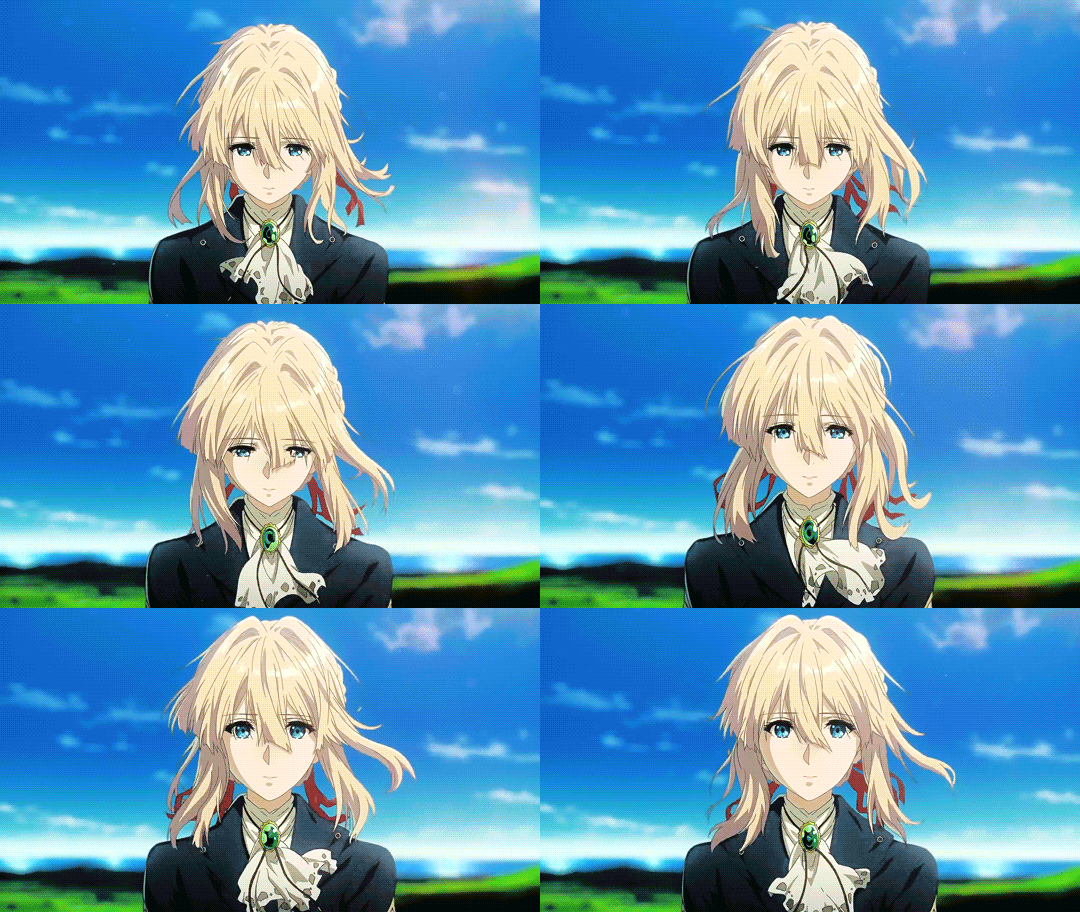
Violet Evergarden is a masterpiece of both animation and storytelling. No matter who you are or what you’ve been through, there will be a part of this story that will speak to you as a human being and touch your heart in ways that no other story can.
There are little flaws here and there: short-cuts in animation, a weaker conclusion that was made better with the optional 14th episode, voice acting that takes a little more emotional maturity to experience to the fullest.
But honestly, this anime has made me a better person. It is one of my all-time favorite animation ever and I will always remember this anime until the end of time.
For these reason, I rate Violet Evergarden a 9.5 out 10.
This series is good. Like wholesome good. Like a “a warm blanket after you just spent hours in the rain and the cold” good. Like a “hug from your best friend after you heartbroken” good. Like a “parent telling you that’s okay, even healthy to cry when you’re hurt” good. A good that makes you kinder, more hopeful, more willing to go the extra mile for those around you. A good that makes you a better person.
I highly recommend that you at least give this show a shot. You very well may regret it if you don’t.
For me, this will be hung on my Wall of Fame as one of the best shows that animation has ever created.
If there are any corrections you’d like to make in regards to this post, please feel free to send me a message with your corrections and I’ll get back to it as soon as I can!
Do you remember a cartoon your friends have never heard of? Got a scene from an animated film that you’re dying to know the name to? Send your questions to The Cartoon Archivist and I’ll see what I’ve got in the vault!

 The Cartoon Archivist